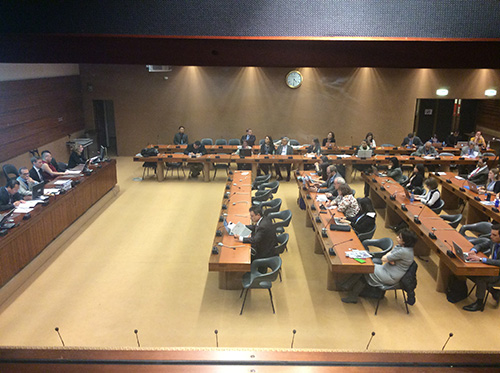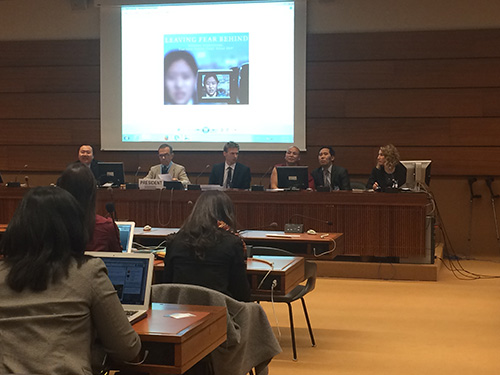
Geneva, 17th March- Golog Jigme Gyatso, a former Tibetan political prisoner called on international community including UN Human Rights Council and its relevant mechanism for their intervention to alleviate the deteriorating human rights situations in Tibet. He gave a testimony, yesterday, at the side event organised by Society for Threatened Peoples. Speakers at the event include International Campaign for Tibet, World Uyghur Congress and Southern Mongolian Human Rights Centre.
“It is unbearable for Tibetans like me to witness China’s wrong-doing policies in Tibet. Therefore, I carried out several campaigns to protest against the Chinese government” said Golog Jigme. All campaigns were carried out non-violently and it had never harmed a single Chinese or destroyed any property, he emphasised.
Delegations from myriad missions including the United States, Norway, Switzerland, Ireland, China and representatives from various international NGOs participated.
On 11 March, while briefing news, Mr. Heiner Bielefeldt, Special rapporteur on Freedom of Religion and Belief, mentioned China over its efforts to control the reincarnation of Tibetan monks. He said such efforts are “really destroying the autonomy of religious communities”.
In a side event on “Religious Repression in East Asia”, he asked why countries like China and Vietnam “should fear religion”. Such countries use religion as a unifying power, as “an instrument” or “administrative process” to control people, said Mr. Bielefeld. In response to the question of pending country visit to China, he said, “long time has arrived for another visit”.
Today, speaking under the UNHRC General Debate under item 4, the European Union expressed its deep concern over the situation in China, including Tibet. EU encouraged China to “address the root causes of unrest in Tibet and Xinjiang”.
The US stated that it remains concerned about human rights in China, including Tibetan and Uyghur. its concern “includes increased arrest, detention and forced disappearance” of people who peacefully question government policies.
The International Rights Groups including Human Rights Watch and UN Watch expressed deep concern over the deteriorating human rights situations in China and including Tibet, Hong Kong and Xinjiang during the General Debate. The Human Rights Watch urged the council to “urgently consider the situation in China”.
On behalf of Society for Threatened Peoples, Ms. Kalden Tsomo delivered an oral statement that drew council’s attention on the deteriorating human rights situation experienced by Tibetan people in Tibet. She highlighted the long standing case of the Panchen Lama, Gedun Choekyi Nyima.
She said, “this year will mark the 2oth anniversary of the enforced disappearance of the 11th Panchen Lama, Gedun Choekyi Nyima. So far there is no progress in this unresolved case. The Chinese authorities continuously fail to reveal any genuine information on this case”.
She urged China to receive an independent expert to investigate the well-being of the 11th Panchen Lama and his family.
Mr. Matteo Mecacci, President of the International Campaign for Tibet speaking on behalf of the Helsinki Foundation, expressed serious concern over deteriorating environment for Tibetan Buddhism during the interactive dialogue with Special Rapporteur on Freedom of Religion and Belief on March 11. He said, “environment for Tibetan Buddhism worsened significantly after the Tibetan protests of March 2008”.
Mr. John Gaudette, a senior researcher at Tibetan Centre for Human Rights and Democracy, on behalf of International Fellowship of Reconciliation (IFOR), on March 13 made an oral intervention on grim health and education situation of Tibetans under China,
The UN Human Rights Council is holding 28th session in Geneva until 27 March. This council will discuss on number of reports submitted by UN Special Procedure mandate holders on thematic and country visits.