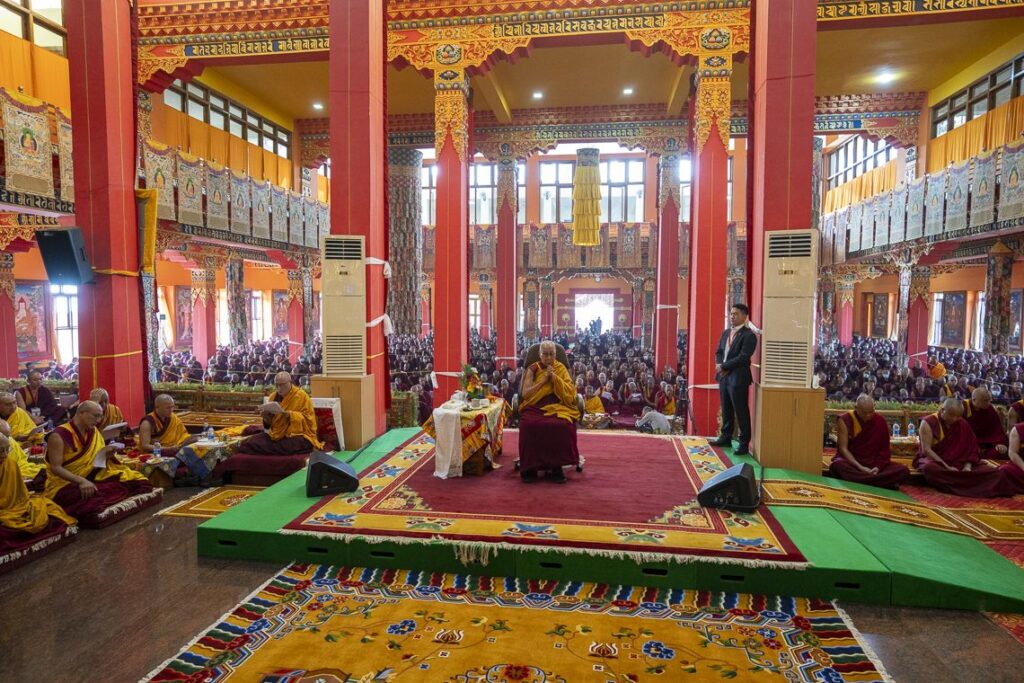
His Holiness meets Tibetans who are based in the Bangalore city. He expressed his happiness at their being able to meet together even for only a short time. He told them that although Tibetans have been in exile for 53 years which is long in terms of an individual’s life, it is short in terms of a people’s struggle for freedom. He was happy to say that in exile Tibetans have been able to keep their traditions and culture and that the spirit of all Tibetans, those in Tibet as well as in exile remains remarkably strong.
He praised India for its democracy, rule of law and religious freedom and spoke of the importance of Tibetans keeping their honesty and integrity intact.
“If you are sincere you can be honest and transparent with others; if you are insincere you will easily become deceitful. Never think that being kind to others is an invitation to them to exploit you.”
He pointed out that there is more to Dharma practice than reciting prayers or playing musical instruments. Tibetan Buddhism is most profound and the Tibetan written and spoken language is ideally suited to expressing that profundity. This is one of the reasons why it is important to use and extend the Tibetan language. Some schools in exile are now teaching modern subjects like science entirely in Tibetan and even employing traditional debate techniques to examine modern topics, which is a positive development.
His Holiness reviewed the steps that had led to his devolving his political responsibilities to the elected Tibetan leadership and ending the nearly 400 year old tradition of the Dalai Lamas wielding both political and spiritual authority.
“In the past when I was travelling abroad, I sometimes worried what would happen to the Tibetan cause if there were to be an accident and I were to die. Now I feel more relaxed and confident that the Tibetan cause can continue without me and that the elected leadership will ensure this. Although I’ve told them that should they need my help, I am ready to give it.”
Addressing students, he said they should understand that Buddhism involves transforming the mind and that they should be able to explain what it was about if fellow students asked. Essentially, he explained, Buddhism is about the view of dependent origination and the conduct of non-violence, helping others if you can, but at least avoiding doing them harm. He also counselled them to reach out to Chinese students who may be studying with them. China will change and these young students may be leaders themselves one day, so it’s worth taking the opportunity to explain the reality of Tibet to them.