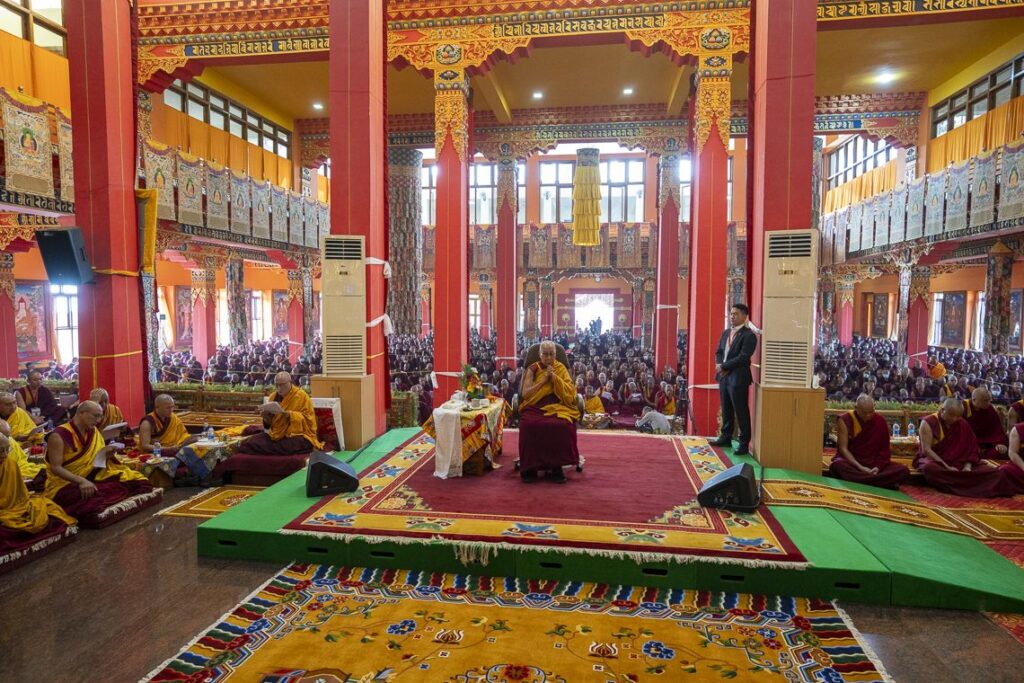
Bangalore, Karnataka, India 27 November 2012 – This morning His Holiness the Dalai Lama drove about 70kms north-west of Bangalore to visit Tumkur University, where he was warmly welcomed on arrival by representatives of the university and monks and lamas of Sera-je Monastic University. Joining him on the dais were Dr Sree Sree Shivakumara Maha Swamiji of the Sree Siddaganga Mutt, Tumkur, who has attained the venerable age of 105; Prof HR Nagendra Vice-Chancellor of S-Vyasa University, a local Yoga University; Dr Apathukatha Shivathanu Pillai, India’s principal rocket scientist; Dr P Sadananda Maiya, a major benefactor of Tumkur University and Prof SC Sharma, the Tumkur University Vice-Chancellor.
Following a resonant invocation by the Sera-je monks, Prof Sharma gave an enthusiastic welcome address and a brief introduction to His Holiness the Dalai Lama. He then requested His Holiness to participate in an exchange of memorandums of understanding first between Tumkur University and Sera-je Monastic University and then between Tumkur University and S-VYAS University to mark the co-operation that is being established between them. His Holiness and Dr Sree Sree Shivakumara Maha Swamiji then lit a lamp to formally inaugurate proceedings. For its part, Sera-je offered a Tibetan style lamp to His Holiness and then offered images of the Buddha to the assembled dignitaries.
Tumkur University was pleased to confer on His Holiness an Honorary Distinguished Professorship, presenting him with a ceremonial shawl and framed certificate. He was then invited to inaugurate the International Conference on Yoga in Education.
He began his talk saying how happy he was to inaugurate this important conference, and went on to thank the University for the great honour of bestowing on him an honorary professorship, remarking jokingly,
“It’s a great honour, especially as I haven’t really done the required study and won’t have any time to do the required teaching!”
“Now, to begin with, I’d like to say a few words about India. Among the several great ancient civilizations, India is one that has given great thought to the nature of reality. Along with the concept of ahimsa or non-violence that has become part of its heritage, this is significant. Ahimsa finds expression, for example, in India’s remarkable and longstanding religious tolerance. This has seen homegrown faiths such as the Samkhya, Hindu traditions, Jainism, Buddhism and later Sikhism, and religions from abroad such as Zoroastrianism, Judaism, Christianity and Islam living harmoniously side by side.”
Meanwhile, in the world at large, in the twentieth century the destructive power of technology reach unthinkable levels with, quite apart from “conventional” warfare, the actual use of nuclear weapons with terrible results. His Holiness recalled visiting both Nagasaki and Hiroshima and meeting survivors who recounted their gruelling experiences. He suggested that if the violence and bloodshed of the twentieth century, in the course of which an estimated 200 million people met violent deaths, had led to a better world it might somehow have been justified, but that was not the case. Therefore, it is important to acknowledge that trying to solve our problems and disputes through violence is completely out of date. We must find a fresh approach and the realistic and humane alternative is to engage instead in dialogue.